
Trophy Components Explained: Understanding Bases, Columns, Plates and Figures
21/08/2026A trophy is rarely just one solid piece. Many traditional awards are assembled from several trophy components, with each part contributing to the award’s appearance, stability, height and personalisation.
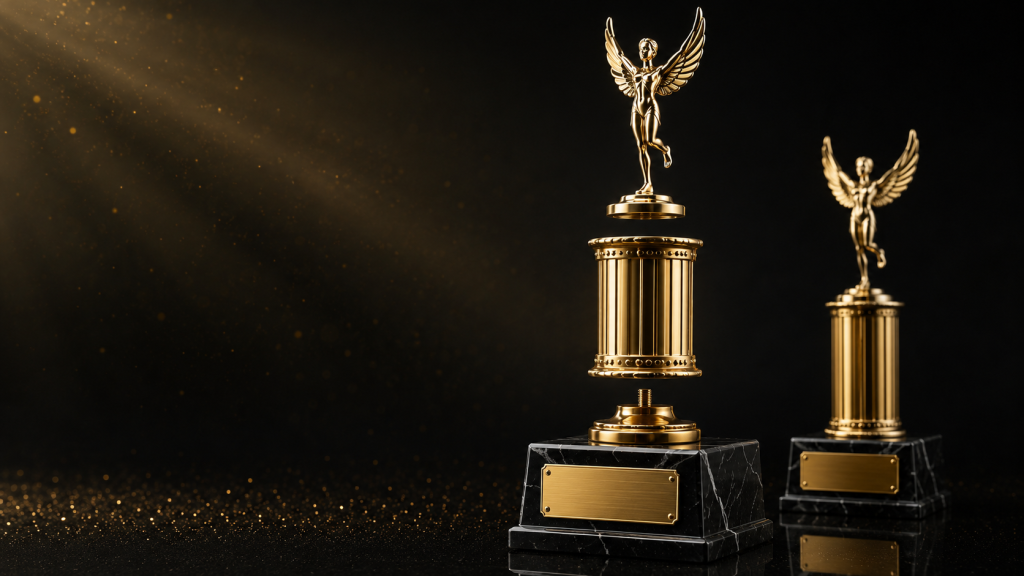
The main components are the base, column or stem, engraving plate and figure or topper. Some designs may also include cups, risers, decorative trims, logo inserts or other connecting pieces. Understanding these elements makes it easier to compare trophies and choose an award that suits the achievement, recipient and presentation setting.
This guide explains what each component does and what Australian schools, sporting clubs, businesses and event organisers should consider before ordering.
The main components of a trophy
The exact construction varies between products. A sporting trophy with a figure on top, for example, will be assembled differently from a championship cup, acrylic award or glass presentation piece.
A component-style trophy commonly includes:
- A base that supports the award
- A column, stem or riser that creates height
- An engraving plate displaying the award details
- A figure, emblem, cup or decorative topper
- Connecting hardware holding the parts together
- Optional logo or activity inserts
These pieces work as a complete design. Changing one can affect the trophy’s proportions, weight, appearance and available personalisation space.
What is a trophy base?
The trophy base is the supporting section at the bottom of the award. It provides stability and usually carries the engraving plate.
Bases are available in different shapes, sizes, colours and materials, depending on the trophy range. The base should be proportionate to the rest of the award: a tall or visually heavy design requires a base that supports it properly, while a smaller participation trophy generally looks better with a more compact foundation.
Why the base matters
The base performs several practical and visual functions:
- It keeps the trophy stable when displayed.
- It creates a finished transition between the award and the surface below.
- It provides space for a nameplate.
- It can add visual weight and formality.
- It helps establish the overall colour and style.
When comparing awards online, look at the whole base rather than focusing only on the topper. Check whether the plate appears large enough for the information you want to include.
Choosing a wooden trophy base
A wooden trophy base can give an award a traditional, substantial appearance. It may suit perpetual awards, service recognition, formal club awards or presentations where a classic finish is preferred.
Timber finishes can also coordinate well with shields, plaques and other traditional recognition pieces. However, the suitability of a particular wooden base depends on the complete trophy design, the required engraving area and the components available for that range.
If you want a timber appearance, confirm whether the selected product uses timber, a timber-finished material or another construction. Product images alone may not always communicate material details clearly.
What are trophy columns and stems?
A column or stem sits between the base and the upper section of a trophy. Its primary purpose is to create height and connect the design visually.
Columns can be straight, tapered, decorative or shaped. Depending on the trophy, a column may be a prominent feature or simply part of the structure supporting the figure or cup.
How columns affect trophy design
Columns influence more than height. They can make an award appear:
- Traditional or contemporary
- Simple or highly decorative
- Slim and elegant or broad and substantial
- Suitable for participation or appropriate for a major award
A taller trophy is not automatically a better trophy. Proportion matters. A long, narrow column beneath a large figure may look unbalanced, while an oversized base can overwhelm a modest topper.
When ordering several award levels, columns can help create a visual hierarchy. First, second and third place might use related designs in different heights, allowing the awards to look coordinated while remaining easy to distinguish.
Timber columns and wooden columns
A timber column can complement a wooden base and create a more traditional award style. Similarly, wooden columns may be appropriate for perpetual trophies, commemorative awards or club presentations where warmth and formality are preferred over a highly metallic finish.
Not every trophy range allows components to be interchanged. If you have a specific combination in mind, ask whether the selected base, column and topper are compatible before confirming the design.
What is the engraving plate?
The engraving plate is the flat panel attached to the trophy base. It carries the information that turns a general award into recognition for a particular person, team or achievement.
Depending on the award and available space, the plate might include:
- Recipient’s name
- Award title
- Team, school, club or business name
- Competition or event
- Year or presentation date
- Division or age group
- Sponsor details
Bayside Discount Trophies completes all engraving on-site at its Wynnum premises, providing direct oversight of the personalisation process. Customers can also discuss logo incorporation where it is appropriate for the selected award.
For more detailed preparation advice, see the guide to ordering engraved trophies.
How much information should go on the plate?
A larger plate does not necessarily mean every available space should be filled. Short, clearly organised engraving is usually easier to read and looks more professional.
A practical format might be:
Jordan Lee
Most Improved Player
Bayside Juniors – 2026
The ideal wording will depend on the award and occasion. A corporate award may place the award category first, while a school trophy might give the student’s name greater prominence.
Before production, check:
- Every recipient’s name
- The official award title
- Dates and years
- Team and organisation names
- Capitalisation and punctuation
- Whether the wording fits the available plate
Submit engraving details in a consistent format, particularly for large club or school orders.
What is a trophy figure or topper?
The figure or topper is the component at the top of many traditional trophies. It helps communicate what the award represents.
Sporting figures may depict a player, ball or piece of equipment associated with the activity. Other toppers may use stars, victory symbols, cups, academic imagery or general achievement designs.
Choosing a relevant figure
Select a figure that recipients can identify easily. A football club might choose a player or ball design, while a school could select a star, academic emblem or general achievement figure.
A generic topper can be a better choice when one trophy must represent several activities or when the award focuses on leadership, service or improvement rather than a particular sport.
Consider the recipient and the award category together. The topper should support the meaning of the award rather than distract from it.
Logo inserts and personalised centres
Some trophy designs include a circular area for a sport image, activity emblem or organisation logo. This can provide a consistent visual identity across several award categories.
If your club, school or business wants to incorporate a logo, provide clear artwork and ask whether the design will remain legible at the required size. Fine text and complicated details may need to be simplified for a small insert.
How trophy components work together
Good trophy design depends on balance. Each component should look like it belongs with the others.
Consider these relationships:
| Component | What to consider |
|---|---|
| Base | Stability, proportion and engraving space |
| Column or stem | Height, style and visual balance |
| Engraving plate | Readability and amount of information |
| Figure or topper | Relevance to the achievement |
| Logo insert | Artwork clarity and brand recognition |
| Overall assembly | Presentation setting, recipient and importance |
For a junior participation award, a compact base, straightforward column and recognisable sporting figure may be appropriate. A championship award may call for greater height, a more substantial base and more detailed personalisation.
Corporate recognition may use a different construction entirely, such as crystal, glass or acrylic, where the shape and engraving surface form an integrated design rather than separate traditional components.
Can you mix and match trophy components?
Some ranges allow a degree of customisation, but components are not universally interchangeable. Bases, columns, figures and connecting pieces need to be compatible in size, proportion and construction.
If you want to create a custom trophy, begin with the purpose rather than choosing separate parts at random. Tell your supplier:
- What the award recognises
- Who will receive it
- The number of awards required
- Your preferred style or material
- The information to be engraved
- Whether a logo should be included
- Your presentation date
- Whether different award levels are needed
This gives the supplier enough context to suggest a workable design rather than an assortment of components that may not suit one another.
Choosing components for different events
Sporting club presentations
For a club presentation, consistency is often important. Using a common base, finish or logo insert across the range can create a unified appearance, even when different figures are used for individual categories.
You may also create an award hierarchy:
- Compact trophies for participation
- Coordinated designs for individual categories
- Larger trophies for major achievements
- A shield or perpetual award for an annual honour
School awards
School awards may recognise sport, academic performance, leadership, attendance, service and the arts. Generic achievement figures or logo inserts can provide flexibility across different categories.
Engraving should clearly distinguish the recipient, award and year. Schools ordering for a large presentation night should prepare and approve the full recipient list before engraving begins.
Business and corporate recognition
Traditional component trophies can suit sales competitions, team challenges and less formal workplace awards. For executive recognition, long service or formal business events, glass, crystal, acrylic or plaque-style awards may be more suitable.
The award should reflect the tone of the occasion and where the recipient is likely to display it.
Common mistakes when selecting trophy components
Choosing by height alone
A tall trophy can attract attention, but height should not come at the expense of stability, proportion or relevance. Compare the full design and materials rather than relying on one measurement.
Treating the engraving plate as an afterthought
The plate contains the information that gives the trophy its meaning. Choose the wording early enough to confirm that it fits the available area.
Using an unrelated figure
A figure that does not match the sport or achievement can make the award feel generic. If there is no suitable activity-specific topper, a star, victory or general achievement design may be more appropriate.
Overcomplicating the design
Combining too many finishes, colours and decorative pieces can result in a busy-looking trophy. A clear focal point and coordinated components often create a stronger presentation.
Assuming every component can be changed
A product may be available only in its displayed configuration, or alternative components may change its appearance and suitability. Ask what can be customised before planning an entire awards range around a particular combination.
Frequently asked questions
Can I change the figure on a trophy?
It depends on the product and whether compatible figures are available. Ask about the specific trophy before ordering rather than assuming the topper can be replaced.
Can a logo be added to a trophy?
Logo incorporation is available for suitable awards. The result will depend on the design, available logo area and quality of the supplied artwork.
What information belongs on the engraving plate?
Include the recipient’s name, award category, organisation and year where space permits. Prioritise the details that will help the recipient remember the achievement.
Are wooden bases suitable for sports trophies?
A wooden trophy base can suit sporting awards, particularly perpetual, championship or formal club presentations. The complete design should still match the event and recipient.
Do all trophies have separate bases, columns and figures?
No. Many traditional trophies use separate components, but resin, acrylic, glass and crystal awards may have an integrated construction. Cups, plaques and shields also use different design structures.
Build the award around the achievement
Understanding trophy components helps you look beyond colour and height. The base provides support, the column establishes proportion, the plate explains the recognition, and the figure gives the award its visual identity.
Choose each element according to the recipient, achievement and presentation setting. A balanced, relevant trophy with clear engraving will usually be more meaningful than one selected purely because it is the largest option.
Bayside Discount Trophies is an Australian family-owned business operated by Nicole and has served Brisbane for more than 17 years. Customers can browse the online trophy catalogues, explore the trophy and award shop or visit the showroom at 2392 Wynnum Road, Wynnum.
For help selecting a design, coordinating an awards range or preparing engraving details, contact Bayside Discount Trophies. Australia-wide delivery is also available.